Visit Dug Bar
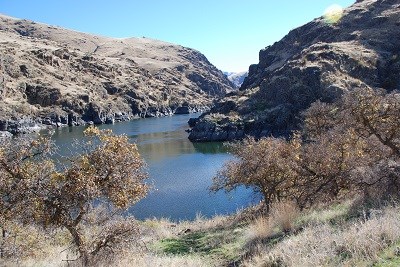
On May 31, 1877, Chief Joseph's band of nimíipuu forded the Snake River at this location while complying with the U.S. government's demand to leave the Wallowa Valley and move to the smaller reservation near Lapwai, Idaho. This crossing marks the beginning of their remarkable journey.
Getting There
Dug Bar is an affiliated site of the Nez Perce National Historical Park, located within Hell's Canyon National Recreation Area and co-managed by the U.S. Forest Service and the National Park Service. It is approximately 31 miles north of Imnaha, Oregon.
From Imnaha, Oregon, head north on Lower Imnaha Road/County Road 755 for 6.5 miles. As the road continues, it becomes Forest Road 4260/Dug Bar Road. Continue on Forest Road 4260 for 24 miles along the Snake River to reach the Dug Bar Boat Launch and Trailhead.
Dug Bar can also be reached by jet boat or float trip on the Snake River. Several Snake River outfitters offer boat tours in this remote area.
What You'll See
The flat bench above the river contains historical ranching structures from the early 20th century and numerous archaeological resources. The site includes a boat launch with a concrete ramp, a vault toilet, and interpretive signage about the Nez Perce Flight of 1877.
A five-mile trail (Trail 1727) stretches between Dug Bar and Forest Road 4260, allowing hikers and horseback riders to follow in the footsteps of Chief Joseph and his people. Other recreational activities include boating, fishing, camping, and hunting. During summer, temperatures can exceed 100 degrees Fahrenheit, so bring plenty of food and water. The dirt road is steep, narrow, and only suitable for high-clearance, four-wheel-drive vehicles.